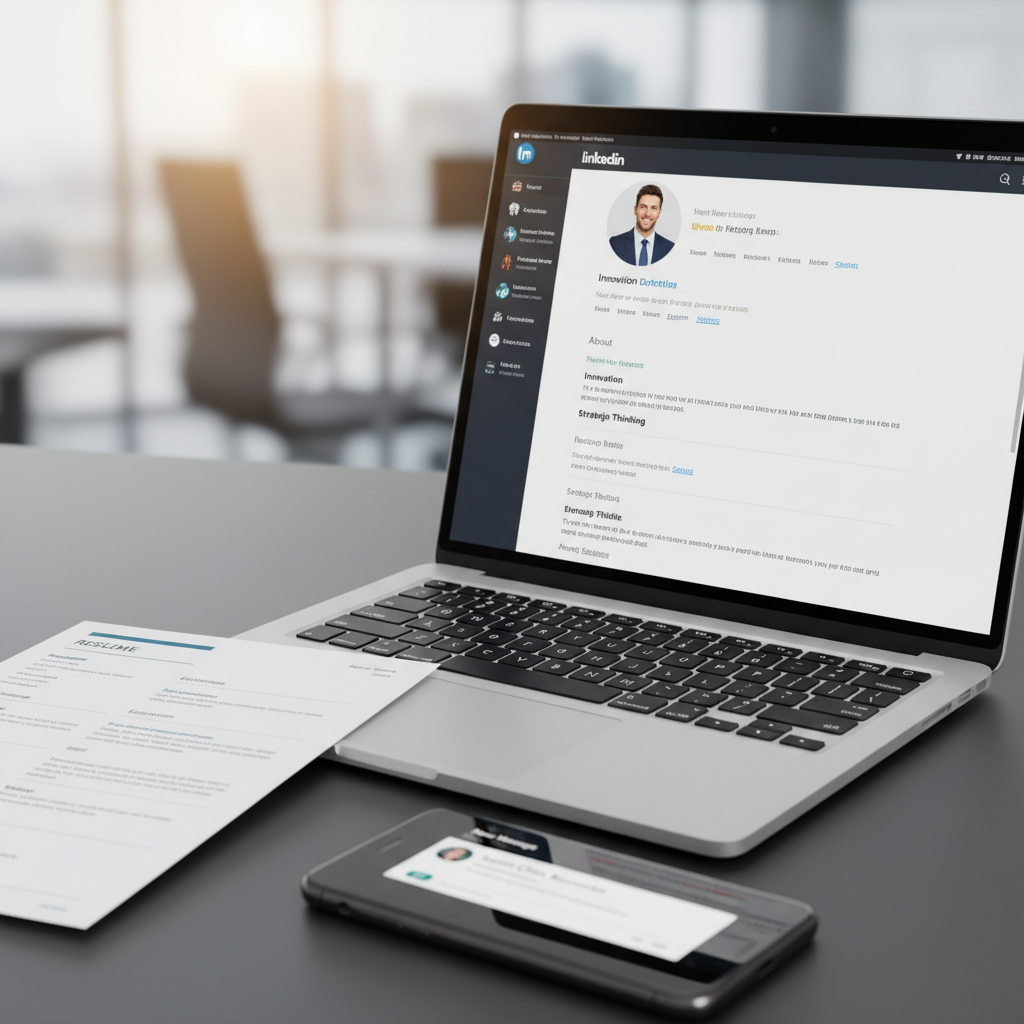

The Email That Changed Everything — Twice
In March 2022, Marcus Webb, a 34-year-old marketing manager from Austin, Texas, applied to what he called his "dream job" — a Senior Brand Strategist role at a mid-sized tech firm in San Francisco. He had tailored his resume for two weeks, rehearsed his interview answers in the mirror, and even flown out on his own dime for a second-round interview. Three days later, the email arrived: "We've decided to move forward with another candidate."
Marcus describes the next 72 hours as "a fog." He stopped checking job boards. He questioned his entire 10-year career. And then, on day four, he did something that would rewrite his professional story: he sent a gracious reply to the hiring manager asking for feedback, rebuilt his resume from scratch using fullCV.online, and applied to 12 more roles — strategically, not desperately — within the next two weeks.
By June 2022, Marcus had three offers on the table. He accepted one at a $22,000 salary increase over the job that had rejected him.
His story isn't a fairytale. It's a repeatable framework. And this article will show you exactly how to execute it.
Why Job Rejection Hurts More Than We Admit
Let's start with the science, because understanding why rejection feels so catastrophic is the first step toward neutralizing its power.
A landmark study published in the Journal of Experimental Psychology found that social rejection activates the same neural pathways as physical pain. In plain English: your brain genuinely cannot distinguish between being ghosted by a recruiter and stubbing your toe. The hurt is real, neurologically speaking.
But here's the compounding problem: job searching itself is a uniquely brutal emotional marathon.
""The average professional sends out 100–200 applications before landing an offer. That means resilience isn't a nice-to-have — it's the single most important job search skill you can develop." — LinkedIn Workforce Report, 2023
According to the U.S. Bureau of Labor Statistics (BLS), the median job search duration in 2023 was 5.5 months. A Glassdoor study found that the average corporate job opening attracts 250 resumes, and only 4–6 candidates get an interview. The math alone should recalibrate how you interpret silence or rejection: you are competing in a lottery, not a meritocracy — and strategic players win lotteries far more often than passive ones.
The Anatomy of a Job Search Setback
Not all rejections are created equal. Before you can respond effectively, you need to diagnose what actually happened.
| Rejection Type | What It Usually Means | Your Best Response |
|---|---|---|
| Application ghosting | Resume didn't pass ATS screening | Optimize resume with keyword-rich formatting |
| Post-interview rejection | Culture fit or compensation mismatch | Request feedback; refine interview narrative |
| Offer rescinded | Budget freeze or internal hire | Ask to stay in talent pool; nurture the contact |
| Final-round loss | Another candidate had a specific edge | Deep-dive debrief; identify skill or story gaps |
| Repeated first-round rejections | Resume or positioning problem | Full resume audit and rewrite |
This diagnostic lens is powerful because it stops you from applying the same generic fix to fundamentally different problems. A candidate who keeps losing at the offer stage has a completely different challenge than one who never gets called for a first interview.
Step 1: Perform a 48-Hour Emotional Reset
Before you do anything tactical, you need to honor the emotional reality of rejection — and then deliberately move past it.
The Research on Bounce-Back Time
A Stanford psychology study on resilience found that high performers consistently practice what researchers call "structured acknowledgment" — they allow themselves a defined window to feel disappointment, then consciously redirect attention. The key word is structured. Wallowing indefinitely is not resilience; it's rumination, and it's neuroscientifically counterproductive.
Your 48-hour reset protocol:
- Hour 0–24: Feel it. Vent to a trusted friend, go for a long run, write an angry journal entry you'll never send. Don't open LinkedIn.
- Hour 24–48: Conduct a calm, analytical post-mortem. What could you have done differently? What couldn't you have controlled? Write it down in two columns.
- Hour 48+: Return to action — with new information.
Step 2: Reverse-Engineer the Rejection
Most job seekers treat rejection as a full stop. Pros treat it as a data point.
Ask for Feedback — and Actually Use It
A Harvard Business Review analysis found that fewer than 20% of rejected candidates ever ask for post-interview feedback, yet 70% of hiring managers say they would provide it if asked respectfully. That's an enormous untapped intelligence source.
Here's a proven template:
"Thank you again for the opportunity to interview for [Role]. I genuinely admire the work your team is doing and would love to improve for future opportunities. If you have 5 minutes, I'd deeply appreciate any feedback on how I can strengthen my candidacy — whether for future roles at [Company] or elsewhere."
This message accomplishes three things simultaneously: it leaves a positive impression, it keeps the door open for future roles, and it extracts actionable data.
Audit Your Resume With Fresh Eyes
If you're being rejected before the interview stage, the problem is almost certainly your resume — either its content, formatting, or ATS (Applicant Tracking System) compatibility. A McKinsey & Company report on talent acquisition noted that over 75% of resumes are filtered out by ATS software before a human ever reads them.
This is where a smart resume builder becomes less of a convenience and more of a competitive necessity. fullCV.online uses AI to analyze your resume against specific job descriptions, flag keyword gaps, and suggest optimizations that help you pass both algorithmic and human screening. The difference between a resume that gets through and one that doesn't is often just 3–5 strategically placed keywords — and most candidates never figure that out.
Step 3: Rebuild Your Job Search Strategy — Not Just Your Resume
Diversify Your Application Channels
One of the most counterproductive habits in a job search is over-relying on a single channel. A LinkedIn Talent Solutions report revealed that 70% of jobs are never publicly posted — they're filled through networks, internal referrals, and proactive outreach. If you're only applying through job boards, you're competing for 30% of available opportunities.
A balanced channel strategy looks like this:
- 30% Job boards (Indeed, LinkedIn, Glassdoor) — for visibility and volume
- 40% Direct networking — LinkedIn outreach, alumni networks, industry events
- 20% Company career pages — applied directly to target companies
- 10% Recruiters and staffing agencies — particularly for specialized or senior roles
Set a Process Goal, Not an Outcome Goal
Outcome goals ("I will land a job by March") create anxiety because they depend on factors outside your control. Process goals ("I will send 5 targeted applications, make 3 networking connections, and do 1 informational interview per week") build momentum and are entirely within your power.
This distinction is backed by goal-setting research from the American Psychological Association, which consistently shows that process-oriented individuals experience less burnout and higher achievement rates in ambiguous, externally dependent pursuits — exactly like job searching.
Step 4: Strengthen Your Competitive Position During the Wait
The time between applications isn't dead time — it's development time. The candidates who succeed fastest are those who use search gaps to actively close the gaps that cost them previous opportunities.
Micro-Skills That Move the Needle
| Skill Gap Identified | Free or Low-Cost Resource | Time to Competency |
|---|---|---|
| Weak data analytics | Google Data Analytics Certificate | 6 months (10 hrs/week) |
| No project management cred | Google Project Management Cert | 6 months |
| Outdated technical skills | Coursera, LinkedIn Learning | 2–8 weeks per course |
| Poor executive presence | Toastmasters, YouTube masterclasses | Ongoing |
| Thin LinkedIn profile | Profile optimization + weekly posting | 2–3 weeks |
Even completing one relevant certification during your search signals to employers that you are a proactive learner — a trait that consistently ranks in the top three qualities hiring managers seek, according to a 2023 LinkedIn Global Talent Trends report.
Step 5: Protect Your Mental Health as a Career Strategy
This isn't a soft add-on. It's table stakes.
A University of Michigan study on unemployment and well-being found that job seekers who maintained consistent routines, social connections, and physical activity found employment an average of 4.2 weeks faster than those who didn't — because they showed up to interviews with more energy, confidence, and presence.
Non-negotiable mental health practices during a job search:
- Maintain a schedule. Treat job searching as a 9-to-5 project, not a 24/7 panic spiral.
- Set a daily cutoff time. After 6 PM, no applications, no refreshing your inbox.
- Celebrate process wins. Got a callback? That's a win. Finished a strong cover letter? That's a win. Progress compounds.
- Connect with a peer group. Job search communities on Reddit, LinkedIn, and Slack normalize the struggle and share insider intelligence.
""Your mental state IS your job search strategy. A burnt-out, demoralized applicant is a losing applicant — regardless of how impressive their resume is."
The Compounding Power of Resilience
Here's the counterintuitive truth about job search motivation: the people who land the best offers are rarely the most qualified candidates in the applicant pool. They are the ones who stayed in the game long enough, adapted quickly enough, and presented themselves confidently enough to be the obvious choice at the right moment.
Career resilience is not a personality trait you either have or don't. It's a practiced discipline — a set of repeatable behaviors that you can learn, refine, and deploy every time the professional road gets rough.
Marcus Webb's story from Austin isn't about luck. It's about a system: a 48-hour reset, an honest audit, a rebuilt resume, a diversified strategy, and an unshakeable commitment to process over panic. That system is available to anyone willing to use it.
Your Next Move Starts Today
Every rejection is a redirect. Every closed door is feedback. And every moment you spend rebuilding smarter is an investment in an offer that will be worth far more than the one that got away.
Start where every successful job search starts: with a resume that works as hard as you do. Head to fullCV.online — the world's leading free AI-powered resume builder — to create, optimize, and ATS-proof your resume in minutes. Because the next opportunity doesn't wait, and neither should you.