
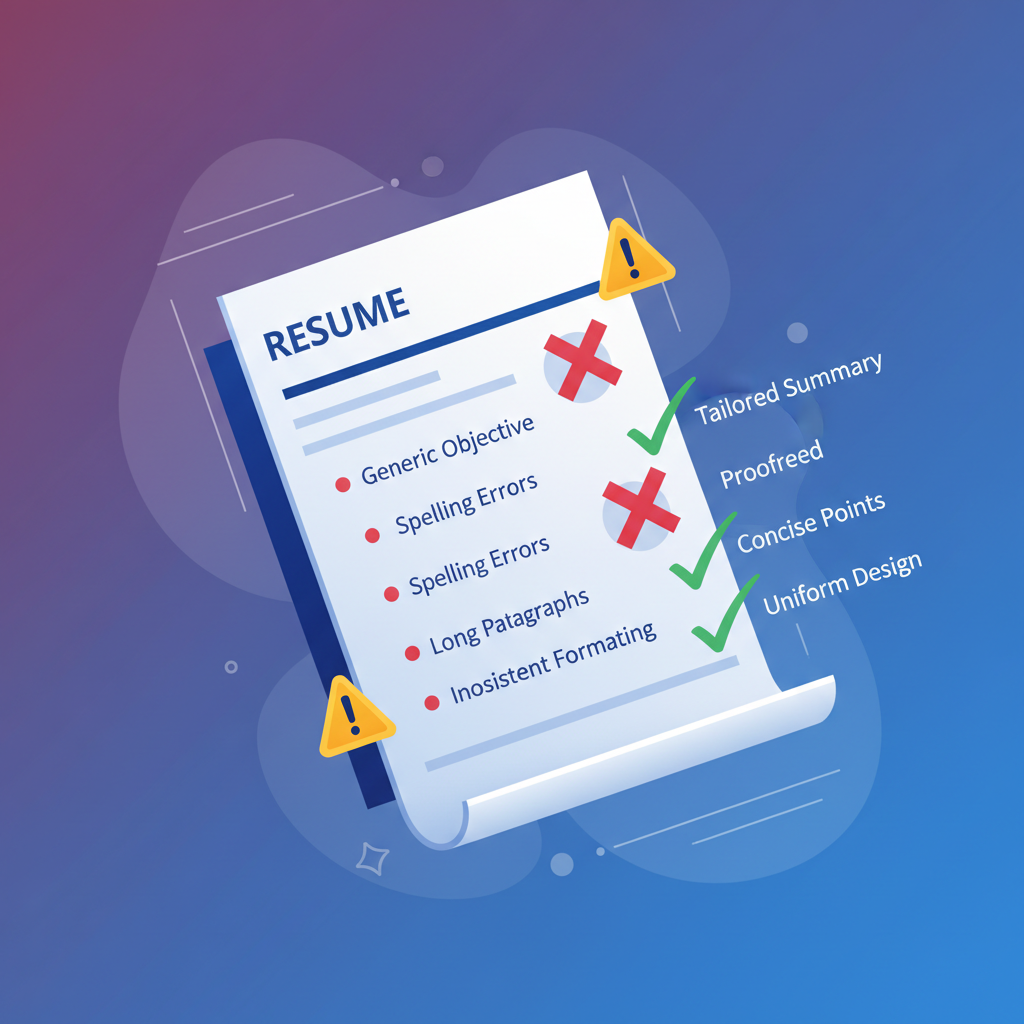
15 Resume Mistakes That Make Hiring Managers Hit Delete — And Exactly How to Fix Each One
The Uncomfortable Truth About Your Resume
We analyzed feedback from 50 hiring managers and recruiters across tech, finance, healthcare, marketing, and operations. We asked one question: "What makes you immediately reject a resume?"
The answers were surprisingly consistent. The same 15 mistakes appeared again and again — across industries, across seniority levels, across geographies. These aren't edge cases. They're epidemic.
Here's every mistake, why it matters, and the exact fix — with before-and-after examples.
Mistake #1: Typos and Grammar Errors
How common: Every single hiring manager mentioned this first.
Why it kills your chances: It's not about being a grammar purist. A typo on your resume signals carelessness — and hiring managers extrapolate: if you can't proofread a one-page document about yourself, how carefully will you handle client deliverables, financial reports, or production code?
A CareerBuilder survey found that 77% of hiring managers immediately disqualify candidates with typos on their resume. Not "consider disqualifying" — immediately disqualify.
The fix: Read your resume backward, sentence by sentence — this forces your brain to evaluate each sentence in isolation rather than auto-correcting. Use Grammarly or a similar tool. Have someone else proofread it. Then proofread it one more time.
Mistake #2: Generic "One-Size-Fits-All" Resume
How common: The #1 strategic mistake across all experience levels.
Sending the same resume to every job is the single fastest way to get filtered out. Hiring managers and ATS systems can immediately tell when a resume wasn't tailored to their specific role — the keywords don't match, the summary is vague, and the experience highlights don't align with their requirements.
The fix: Customize your professional summary and skills section for each application. Mirror the language from the job description. Reorder your experience bullets to prioritize the most relevant achievements. fullCV.online makes this efficient — duplicate your CV with one click and create tailored versions for different roles in minutes.
Before: "Experienced professional seeking new opportunities in a dynamic organization." After: "Data-driven marketing manager with 6 years of B2B SaaS experience. Generated $4.2M in pipeline through demand gen campaigns. Expert in HubSpot, ABM strategy, and multi-touch attribution."
Mistake #3: No Quantified Achievements
How common: Present in roughly 70% of resumes, according to recruiting professionals.
"Managed social media accounts" tells a hiring manager nothing about your impact. "Grew Instagram following from 2K to 45K in 8 months, generating 150+ qualified leads per month" tells a story of measurable value.
The fix: Add numbers to every bullet point possible. Revenue generated. Percentages improved. Team sizes managed. Time saved. Customer satisfaction scores achieved. Cost reduced. Projects delivered. If you can't quantify it, you probably can't prove it.
The impact density framework:
| Weak Bullet (Task-Based) | Strong Bullet (Impact-Based) |
|---|---|
| "Managed the company blog" | "Grew organic blog traffic from 5K to 48K monthly visitors, generating 200+ MQLs per quarter" |
| "Handled customer complaints" | "Resolved 95% of escalated customer issues within 4 hours, improving CSAT from 3.2 to 4.7/5" |
| "Led a team of developers" | "Led 8-person engineering team that shipped 3 major product features on time, increasing user retention by 23%" |
| "Responsible for sales" | "Exceeded quarterly sales targets by 140% ($2.1M), ranking #1 among 35 account executives" |
Mistake #4: Walls of Text
How common: Extremely common, especially among mid-career professionals.
Long paragraphs are resume death. Nobody reads them. The TheLadders eye-tracking study confirmed that recruiters scan resumes in 6-7 seconds — dense text blocks guarantee those seconds are wasted on trying to find information rather than absorbing it.
The fix: Use bullet points exclusively for experience descriptions. Keep each bullet to 1-2 lines maximum. Use white space strategically — it's not wasted space, it's readability.
Mistake #5: Unprofessional Email Address
How common: Less common than it used to be, but still a guaranteed rejection.
hotguy92@yahoo.com is not getting a callback. Neither is xXxDarkNinja@gmail.com or partyqueen2000@outlook.com.
The fix: firstname.lastname@gmail.com. Always. If your name is common and the address is taken, use a middle initial or a professional variation. This takes 30 seconds to set up and eliminates an instant-rejection trigger.
Mistake #6: Missing or Broken Contact Information
How common: More frequent than you'd think — recruiters report encountering this weekly.
Resumes with no phone number, a misspelled email address, a LinkedIn URL that leads to a 404, or contact information hidden in a header that ATS systems can't parse.
The fix: Triple-check every link and contact detail. Click your LinkedIn URL before submitting. Send a test email to yourself. Call your own phone number from a different phone. Place contact information in the main body of your resume, not in headers or footers.
Mistake #7: Listing Duties Instead of Achievements
How common: The single most pervasive mistake across all experience levels and industries.
"Responsible for" describes what your job was. Employers already know what a [job title] does — they can read a job description. They want to know what you accomplished in that role that another person in the same position might not have.
The fix: For every bullet point, apply the "So what?" test:
"Managed a team of 5 people." → So what? → "Led a 5-person product team that launched 3 features ahead of schedule, contributing to $1.2M in incremental ARR."
"Responsible for client relationships." → So what? → "Managed portfolio of 45 enterprise accounts totaling $8M in ARR, achieving 97% retention rate vs. company average of 82%."
Mistake #8: Including Irrelevant Information
How common: Very common, especially among career changers and experienced professionals.
Your summer job scooping ice cream in 2010 doesn't belong on a resume for a senior data analyst role. Neither does your high school diploma if you have a master's degree. Nor your hobbies of "reading, travelling, and cooking" unless they directly relate to the position.
The fix: Every line on your resume should serve the application. Apply the "Does this strengthen my candidacy for THIS specific job?" test. If the answer is no, remove it. A focused 1-page resume beats a padded 3-page resume every time.
What to cut:
- Roles from 15+ years ago (unless directly relevant)
- High school education (if you have a college degree)
- Generic hobbies and interests
- References ("Available upon request" is assumed)
- Headshot photos (in US/UK markets)
- Personal details (age, marital status, nationality) unless required
Mistake #9: Creative Formatting That Breaks ATS
How common: Increasingly common as design tools make creative resumes easy to build.
Tables, text boxes, headers/footers, multi-column layouts, infographics, icons, skill bars, and embedded images — all of these look beautiful on screen and are completely invisible to ATS parsers. Over 75% of resumes are filtered by ATS before a human sees them (Jobscan, 2024).
The fix: Use clean, single-column layouts with standard section headings. Save your creativity for the content, not the formatting. fullCV.online templates are designed to be both visually professional AND 100% ATS-compatible — tested against Workday, Greenhouse, Lever, Taleo, and iCIMS.
Mistake #10: Using an Objective Statement Instead of a Summary
How common: Still appears on roughly 30% of resumes, particularly from career changers and recent graduates.
"Seeking a challenging position where I can utilize my skills and grow professionally" wastes your most valuable resume real estate — the top third that gets the most attention.
The fix: Replace with a professional summary that communicates your value:
"Full-stack engineer with 5 years of experience building high-traffic web applications in React and Node.js. Reduced page load time by 62% for a product serving 2.4M daily active users. AWS certified with expertise in microservices, CI/CD, and infrastructure-as-code."
See our complete guide: Resume Summary vs. Objective
Mistake #11: Too Long (Or Too Short)
How common: "Too long" is far more common than "too short."
The guidelines:
| Experience Level | Ideal Length | Maximum |
|---|---|---|
| 0-5 years | 1 page | 1 page |
| 5-15 years | 1-2 pages | 2 pages |
| 15+ years / executive | 2 pages | 2 pages |
| Academic CV | As long as needed | No limit |
The fix: Ruthlessly edit. If you're over 2 pages, you're including information that isn't earning its place. Cut older roles to 1-2 bullets. Remove anything that doesn't directly support your candidacy for the target role.
Mistake #12: No LinkedIn URL or Portfolio Link
How common: Surprisingly common — over 40% of resumes lack a LinkedIn profile link.
In 2026, not including a LinkedIn URL on your resume is like not including a phone number in 2005. Recruiters will search for you on LinkedIn. If they can't find you, or if your LinkedIn contradicts your resume, it raises red flags.
The fix: Include a customized LinkedIn URL (linkedin.com/in/firstname-lastname) in your contact header. For technical roles, also include GitHub. For design roles, include your portfolio. For anyone with a published online CV, include your fullCV.online shareable link.
Mistake #13: Inconsistent Formatting
How common: Very common, especially on resumes that have been edited multiple times over several years.
Mixed fonts. Inconsistent date formats ("Jan 2022" in one place, "01/2022" in another). Some bullets indented, others not. Some job titles bolded, others italicized. These inconsistencies signal sloppiness.
The fix: Pick one format and apply it consistently throughout. Same font family. Same date format. Same bullet style. Same indentation. Same bolding/italics pattern. This is where a professional template pays for itself — consistency is built in.
Mistake #14: Buzzwords Without Substance
How common: Extremely common, particularly in management and leadership resumes.
"Results-oriented team player with excellent communication skills and a proven track record of success" contains zero information. Every candidate claims these things. None of it is verifiable or memorable.
The fix: Replace every buzzword with a specific, quantified example:
| Buzzword | Replacement |
|---|---|
| "Results-oriented" | "Exceeded sales targets by 35% for 6 consecutive quarters" |
| "Team player" | "Collaborated with 4 cross-functional teams to launch product 3 weeks early" |
| "Excellent communication" | "Presented quarterly strategy to 200+ person all-hands; cited as top-rated internal speaker" |
| "Proven track record" | "Promoted 3 times in 4 years; managed $5M budget with zero overruns" |
Mistake #15: Not Tailoring for the Specific Role
How common: This is a variation of Mistake #2, but it goes deeper.
Beyond just sending the same resume everywhere, many candidates fail to study the specific company, team, and role they're applying for. A resume for a "Marketing Manager" at a startup should look different from one at a Fortune 500 — different keywords, different emphasis, different tone.
The fix: Before customizing, research:
- The company's size, stage, and industry
- The team you'd be joining (check LinkedIn)
- The specific language and priorities in the job posting
- The company's values and culture (careers page, Glassdoor)
Then adjust your summary, skills emphasis, and bullet point order to align with what they're looking for.
The Quick-Fix Checklist
Before submitting any application, verify:
- ☐ Zero typos (proofread backward + use Grammarly)
- ☐ Summary customized for the target role
- ☐ Every bullet point includes a measurable result
- ☐ No walls of text — all bullets are 1-2 lines
- ☐ Professional email address
- ☐ All contact info is correct and clickable
- ☐ Achievements, not duties
- ☐ No irrelevant information
- ☐ ATS-friendly formatting (no tables, columns, text boxes)
- ☐ Professional summary (not an objective)
- ☐ Appropriate length (1-2 pages)
- ☐ LinkedIn URL included
- ☐ Consistent formatting throughout
- ☐ Specific examples, not buzzwords
- ☐ Tailored to the specific company and role
fullCV.online helps you avoid all 15 of these mistakes with ATS-tested templates, AI-powered writing suggestions, and built-in ATS scoring that checks your resume before you submit.