
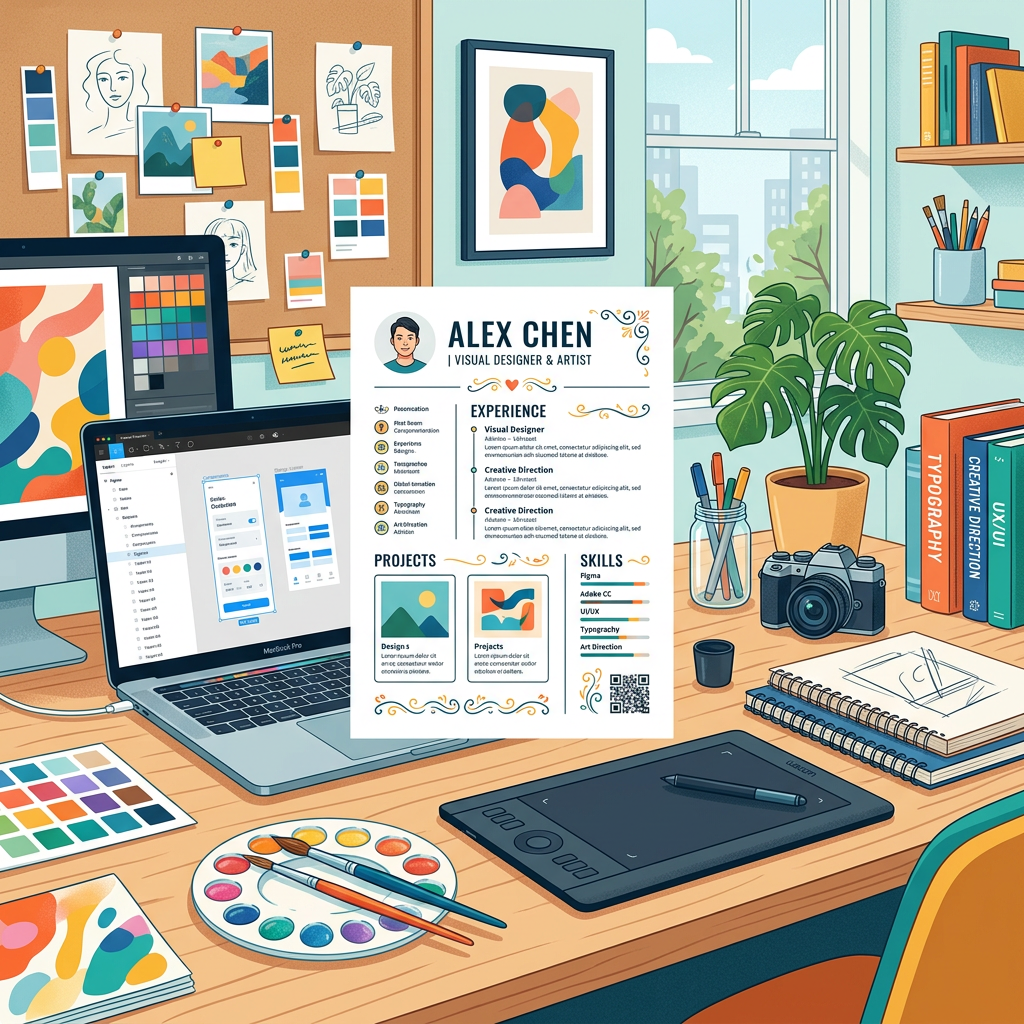
The Creative Resume Paradox
Creative professionals face a unique tension: you want your resume to showcase your design sensibility, but it also needs to pass ATS screening and communicate clearly to non-creative hiring managers and HR teams.
The solution is a resume that's clean and professional by default, creative in subtle details.
Resume vs. Portfolio
Understand what each does:
| Resume | Portfolio | |
|---|---|---|
| Purpose | Business impact of your work | Visual showcase of your work |
| Audience | HR, recruiters, ATS | Creative directors, design leads |
| Format | Structured, text-based | Visual, project-based |
| Content | Achievements + metrics | Process + outcomes |
Your resume gets you to the portfolio review. Your portfolio gets you the interview. You need both.
Structure for Creative Resumes
- Professional Summary (your creative specialty + business impact)
- Skills (tools, methodologies, specialties)
- Experience (achievement-focused, not just "designed things")
- Portfolio Link (prominent — don't bury it)
- Education & Certifications
- Awards & Recognition (if applicable)
Writing Creative Experience Bullets
The mistake: describing what you designed. The fix: describing the impact of what you designed.
Graphic Designer
Weak: "Designed marketing materials for social media" Strong: "Designed and produced 200+ social media assets for product launches, contributing to a 45% increase in engagement rate and 28% growth in follower base over 6 months"
UX Designer
Weak: "Created wireframes and prototypes" Strong: "Led end-to-end UX redesign of the checkout flow, reducing cart abandonment by 22% and increasing mobile conversion by 31% (A/B tested with 50K users)"
Copywriter
Weak: "Wrote blog posts and email campaigns" Strong: "Developed content strategy and wrote 100+ blog posts that grew organic traffic from 15K to 180K monthly sessions, generating 2,400 qualified leads per quarter"
Art Director
Weak: "Managed the visual direction of campaigns" Strong: "Art directed a brand refresh for a Fortune 500 client, overseeing a team of 6 designers and delivering a visual identity system adopted across 14 markets globally"
Tool Proficiency Section
Creative roles require specific tool knowledge. List them clearly:
Design: Figma, Sketch, Adobe Creative Suite (Photoshop, Illustrator, InDesign, XD) Motion: After Effects, Premiere Pro, Cinema 4D Prototyping: Figma, InVision, Principle, Framer Web: HTML/CSS, WordPress, Webflow 3D: Blender, Cinema 4D, SketchUp
ATS vs. Creative Design
Here's the practical approach:
- Create an ATS-optimized version for online applications (clean, single-column, text-based)
- Create a designed version for direct emails, networking, and portfolio presentations
- Use your online CV from fullCV.online as a living resume that's always accessible
The ATS version gets you past the robots. The designed version impresses the humans.
Portfolio Integration
Make your portfolio impossible to miss:
- Include the URL in your contact header
- Add it to your email signature
- Link it in your LinkedIn Featured section
- Mention it in your professional summary
- Create a shareable profile on fullCV.online that links to your portfolio
Build Your Creative Resume
fullCV.online offers templates that balance visual polish with ATS compatibility. Customize colors, fonts, and layout to reflect your creative sensibility while maintaining the structure that gets through automated screening.