
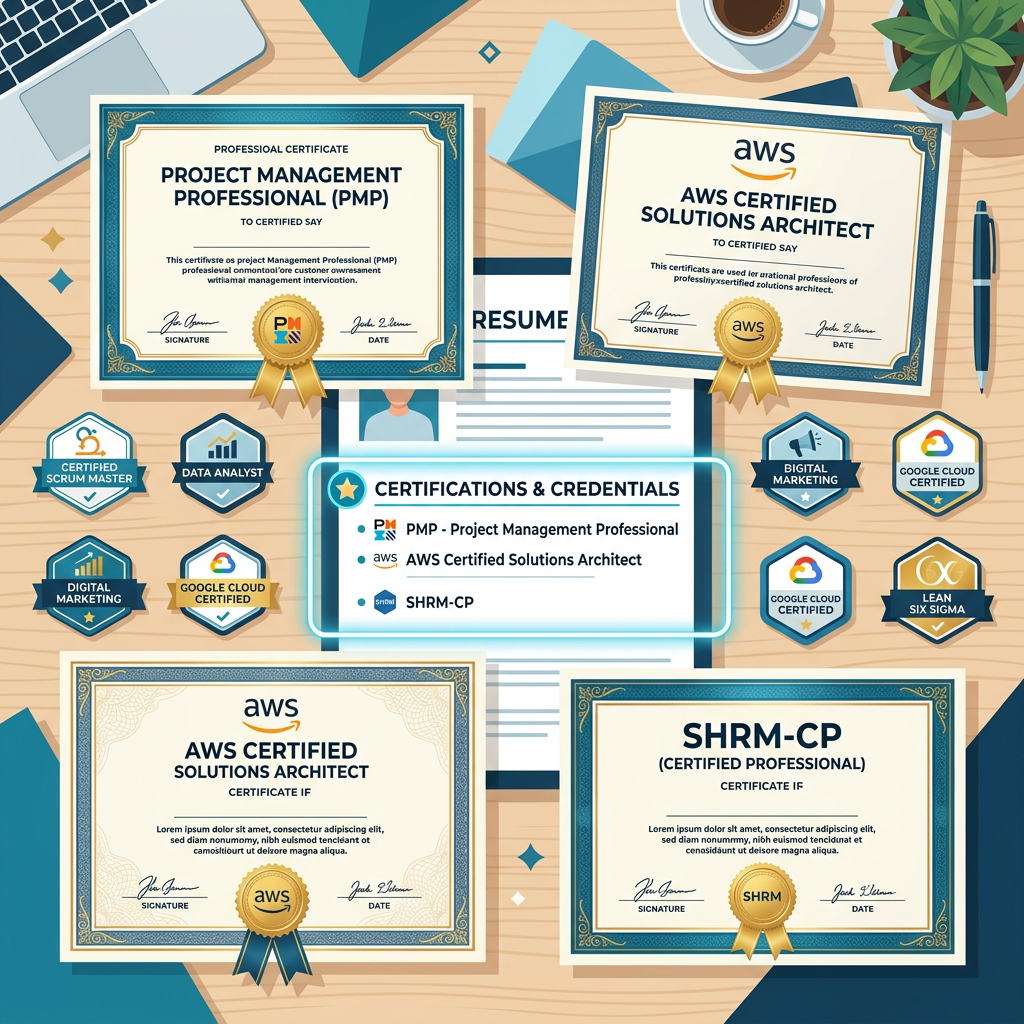
Certifications: Your Professional Currency
In a competitive job market, certifications serve as third-party validation of your skills. They tell employers: this isn't just a claim on a resume — an authoritative body has verified this competency.
But not all certifications carry equal weight. Here's how to decide what to include and how to present it.
Which Certifications to Include
Always include:
- Industry-required certifications (CPA for accountants, RN for nurses, PE for engineers)
- Certifications mentioned in the job description
- Well-known professional certifications (PMP, AWS Solutions Architect, CFA, PHR)
- Vendor-specific certifications for technical roles (Google Cloud Professional, Salesforce Administrator, HubSpot Inbound)
Include if relevant:
- MOOCs and online courses from recognized platforms (Coursera specializations from top universities, Google Career Certificates)
- Bootcamp certificates from well-known programs
- Industry association certifications (AMA, SHRM, PMI)
Skip:
- Expired certifications (unless recently expired and you're renewing)
- Irrelevant certifications (food handler's cert on a software engineer's resume)
- Very basic certifications (Microsoft Office, unless it's a requirement)
- Internal company training (unless universally recognized)
How to Format Certifications
Standard format:
Certification Name | Issuing Organization | Year Obtained
Examples:
- PMP (Project Management Professional) | Project Management Institute | 2024
- AWS Solutions Architect – Associate | Amazon Web Services | 2025
- Google Data Analytics Professional Certificate | Google / Coursera | 2025
- Certified ScrumMaster (CSM) | Scrum Alliance | 2023
Include credential IDs when:
- The employer might verify them
- The certification is highly valued (AWS, Google, Azure)
Where to Place Certifications
Placement depends on how central they are to your candidacy:
After your name (for licensed professions):
"Jane Smith, CPA, CFA"
In a dedicated Certifications section (standard):
Place below Education or Skills.
In your Skills section (for technical certs):
Group with related technical skills.
In your Summary (for key differentiators):
"AWS-certified cloud architect with 8 years of experience..."
High-Value Certifications by Industry
Technology:
- AWS Certified Solutions Architect
- Google Professional Cloud Architect
- Certified Kubernetes Administrator (CKA)
- CompTIA Security+
- Certified Information Systems Security Professional (CISSP)
Business & Management:
- PMP (Project Management Professional)
- Certified ScrumMaster (CSM)
- Six Sigma Green/Black Belt
- ITIL Foundation
Marketing:
- Google Analytics Certification
- HubSpot Inbound Marketing
- Meta Certified Digital Marketing Associate
- Google Ads Certification
Finance:
- CFA (Chartered Financial Analyst)
- CPA (Certified Public Accountant)
- FRM (Financial Risk Manager)
- CFP (Certified Financial Planner)
HR:
- PHR/SPHR (Professional in Human Resources)
- SHRM-CP/SHRM-SCP
Free Certifications Worth Getting
If you want to strengthen your resume without spending much:
- Google Career Certificates (Data Analytics, IT Support, UX Design, Project Management)
- HubSpot Academy (Inbound Marketing, Content Marketing, Sales)
- AWS Cloud Practitioner (entry-level cloud certification)
- Google Analytics (essential for any marketing role)
- Coursera specializations from top universities
Build Your Credentialed Resume
fullCV.online includes a dedicated certifications section with proper formatting. Add your credentials, and they'll appear professionally formatted and positioned for maximum ATS impact.