Remote Work Productivity: How Top Performers Structure Their Day
On March 16, 2020, Elena Rostova, a senior product manager at a Chicago-based fintech firm, set up her laptop on a wobbly ironing board in her bedroom. She worked for twelve hours straight, fueled by anxiety and stale coffee, convinced that visibility equaled viability. By October 2020, she was burned out, nursing chronic back pain, and her productivity metrics had plummeted by 18%.
Fast forward to November 2023. Elena is now a Director of Engineering at a fully distributed unicorn startup. She works from a dedicated home office in Denver. Her calendar is 40% empty space. She finishes her day at 3:30 PM to hike. Yet her output has doubled compared to her in-office days, and she recently led the launch of a product that drove $4M in Q3 revenue.
Elena isn't an anomaly; she is a case study in evolution. The initial shock of the remote revolution has settled, revealing a distinct divide in the workforce. There are those who merely survive working from home, trying to replicate the office environment remotely, and then there are the "Remote Natives" — top performers who have fundamentally re-engineered how they work.
This article dissects the anatomy of elite remote work productivity, backed by research from Stanford and McKinsey, to show you exactly how the best remote workers structure their day — and how to apply their strategies to your own work.
The Science of Non-Linear Work: Why 9-to-5 Is Dead
One of the most pervasive myths about remote work is that you should stick to your office hours. Research suggests the 9-to-5 model is a relic of the industrial revolution, designed for factory floors, not knowledge work.
A landmark study by Nicholas Bloom at Stanford University followed 16,000 workers over nine months. The findings were unequivocal: working from home resulted in a 13% performance increase. This wasn't due to working longer hours, but rather working quieter hours. The study attributed the boost to fewer distractions, a more comfortable environment, and — critically — the flexibility to work during personal peak productivity windows.
""The goal of remote work is not to bring the office to the home, but to bring the work to the life. It requires a shift from measuring hours to measuring outcomes." — Dr. Cal Newport, Author of Deep Work
Top performers understand that remote work allows for non-linear workdays. Instead of an 8-hour marathon, their day is a series of strategic sprints with intentional recovery periods.
The Asynchronous Advantage
High-performers leverage asynchronous communication as a productivity multiplier. In an office, someone taps your shoulder every 15 minutes. In a high-functioning remote setup, you write a detailed brief, your colleague reads it when they're ready, and nobody's focus was interrupted.
According to a 2022 GitLab survey, 52% of remote workers cited "more time for focused work" as the top benefit of remote work. The best workers batch their communications into specific windows, leaving the rest of the day open for deep, uninterrupted work:
| Communication Window | Time | Duration | Purpose |
|---|---|---|---|
| Morning sync | 9:00 AM | 30 min | Check Slack, email, respond to blockers |
| Midday review | 1:00 PM | 20 min | Review messages, respond to questions |
| End-of-day wrap | 4:30 PM | 30 min | Final responses, set expectations for tomorrow |
| Total communication time | 80 min | Leaves 5+ hours for deep work |
The Cognitive Cockpit: Designing Your Environment for Flow States
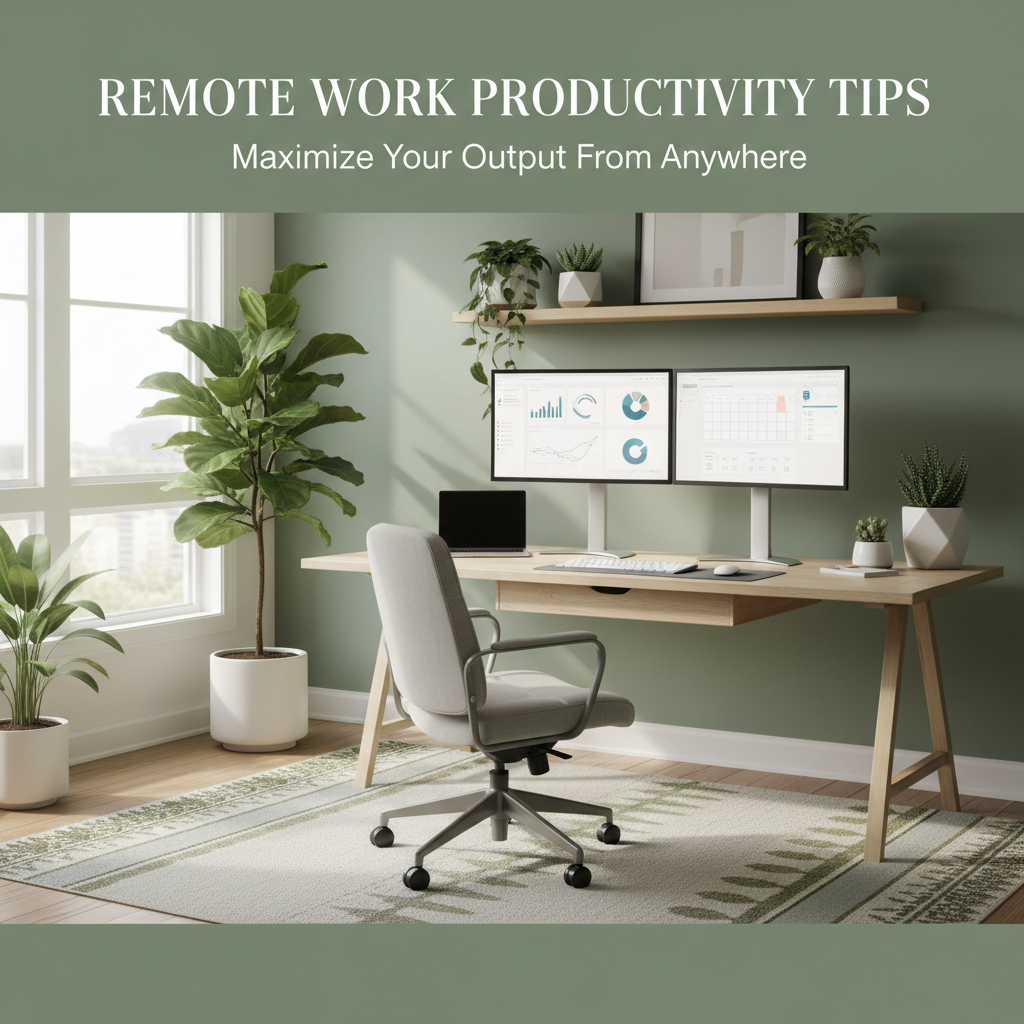
Your environment dictates your output. Top performers treat their home office setup like a pilot treats a cockpit — everything essential is within reach, and all distractions are eliminated.
Research in environmental psychology shows that physical spaces create contextual cues that prime the brain for specific activities. A dedicated workspace physically separated from living areas creates an automatic mental shift: when you sit in this chair, your brain knows it's time to work.
The Three-Zone Model
The most productive remote workers organize their physical space into distinct zones:
| Zone | Purpose | Setup | Rules |
|---|---|---|---|
| Focus Zone | Deep work: coding, writing, strategic thinking | Dedicated desk, facing away from high-traffic areas. No phone. Noise-canceling headphones. | No Slack. No email. Timer-based focus sprints. |
| Admin Zone | Shallow work: email, Slack, scheduling, approvals | Standing desk or comfortable secondary space | Batch processing. Time-boxed to specific windows. |
| Recovery Zone | Breaks, reading, thinking | Physically separate from work tech — a balcony, a different room, a comfortable chair | No screens. Active rest only. |
The key principle: different spaces for different cognitive demands. When you do deep work at the same desk where you check Slack, your brain never fully enters flow state because it's been conditioned to expect interruptions in that space.
The Minimum Viable Setup
You don't need a $5,000 home office. Here's what the research suggests actually matters:
| Element | Why It Matters | Minimum Investment |
|---|---|---|
| External monitor | 33% productivity increase on multi-tab work (University of Utah) | $150-300 |
| Ergonomic chair | Reduces fatigue, improves focus duration | $200-500 |
| Good lighting | Reduces eye strain, improves mood and alertness | $30-60 (desk lamp) |
| Noise-canceling headphones | Eliminates environmental distractions | $80-350 |
| External keyboard/mouse | Reduces strain, improves typing speed/accuracy | $50-100 |
| Camera at eye level | Professional video presence (important for visibility) | $15 (laptop stand) |
The Daily Architecture: How Top 1% Remote Workers Structure Their Day
We analyzed schedules from high-performing remote workers at companies like Automattic, Doist, GitLab, and Buffer. The pattern is strikingly consistent.
The "Fake Commute"
The elimination of the commute had an unintended side effect: the loss of a psychological decompression buffer between "home mode" and "work mode." Top performers re-introduce this intentionally.
The morning ritual (7:30–8:30 AM):
- Wake up, hydrate (no screens for first 20 minutes)
- "Fake commute" — a 15-20 minute walk, podcast, or gym session
- This ritual signals to the brain: work is starting
The Optimal Day Structure
| Time Block | Activity | Cognitive State | Key Principle |
|---|---|---|---|
| 8:30-9:00 | Plan the day. Identify the #1 priority ("Eat the Frog"). | Warm-up | Don't check email first. Plan first. |
| 9:00-11:30 | Deep Work Sprint #1 (the most cognitively demanding task) | Peak focus | No Slack. No meetings. Phone in another room. |
| 11:30-12:00 | Communication Window #1 (Slack, email, quick responses) | Admin | Time-box strictly. Don't let it bleed. |
| 12:00-1:00 | Lunch + movement (walk, stretching, errands) | Recovery | Physical movement is essential, not optional. |
| 1:00-1:30 | Communication Window #2 + meetings (if any) | Admin | Batch all meetings into this afternoon slot. |
| 1:30-3:30 | Deep Work Sprint #2 (secondary priority tasks) | Sustained focus | Slightly lower intensity than morning sprint. |
| 3:30-4:00 | Wrap-up: review today, plan tomorrow's #1 priority | Wind-down | This is the "shutdown ritual." |
| 4:00-4:30 | Communication Window #3 (final responses, set expectations) | Admin | After this: laptop closed. Day over. |
Comparison: Average vs. Top Performer
| Dimension | Average Remote Worker | Top Remote Performer |
|---|---|---|
| Morning start | Rolls out of bed, checks email immediately | "Fake commute," no screens for first 20 min |
| Schedule style | Linear (9-5 continuous) | Modular (Sprint → Rest → Sprint → Rest) |
| Slack/Teams status | Always green, always available | DND for 4+ hours/day during deep work |
| Breaks | Doom-scrolling social media | Physical movement, household chores, nature |
| End of day | Work bleeds into evening; laptop stays open | Hard shutdown ritual; laptop closed at set time |
| Meeting approach | Accepts all meetings, scattered throughout day | Batches meetings; declines/converts non-essential to async |
| Documentation | Verbal updates, ad-hoc DMs | Written pre-reads, post-meeting summaries, public updates |
Documentation Is the New Charisma
In a physical office, you can get by on charm and visibility. Walk past the CEO enough times, laugh at the right jokes, and your presence does half the work. In a remote setting, you are only as good as your written word.
Top performers write things down obsessively. They don't just have a Zoom call; they send a pre-read document before the call and a summary after. This practice, called "working out loud," ensures that your contributions are visible even when you aren't.
Strategic Visibility
Elite remote workers use public channels for updates rather than direct messages. Instead of DMing a boss "I finished the report," they post in the team channel:
"@channel The Q3 revenue analysis report is live [link]. Key findings: revenue grew 23% QoQ, driven primarily by enterprise segment expansion. Three recommendations for Q4 included. Happy to discuss in comments or async."
This single message accomplishes four things:
- Demonstrates completed work (accountability)
- Shows quality of thinking (competence)
- Invites discussion without requiring a meeting (async-friendly)
- Is visible to leadership and peers (strategic visibility)
Managing Energy, Not Time
The McKinsey Global Institute estimates that productivity could increase by up to 25% through effective digital collaboration — but only if energy is managed correctly.
Top performers track their biological chronotypes and schedule accordingly:
| Chronotype | Peak Creative Hours | Best Meeting Times | Deep Work Strategy |
|---|---|---|---|
| Early bird ("Lark") | 6-10 AM | After 1 PM | All deep work before noon |
| Night owl | 8 PM-12 AM | Before 2 PM | Admin in morning, deep work at night |
| Intermediate | 9 AM-12 PM | Early afternoon | Standard morning deep work blocks |
If you're forcing yourself to write code at 9 AM when your brain doesn't activate until 11 AM, you're wasting the primary benefit of remote work: the flexibility to align work with your biology.
The Shutdown Ritual
Work-life balance is a myth in remote work; work-life boundaries are a discipline. Burnout in remote workers stems primarily from the inability to disconnect. Top performers have a strict shutdown ritual:
- Review today's completed tasks (celebrates progress)
- Write tomorrow's #1 priority (reduces morning decision fatigue)
- Close all tabs and applications (physical separation)
- Say a phrase out loud or physically leave the room ("System shutdown")
- Do not reopen the laptop after this point
This ritual takes 5 minutes. It prevents hours of evening anxiety.
The Remote Productivity Checklist
To operate like a top-performing remote worker:
- ☐ Dedicated workspace physically separated from living areas
- ☐ Three-zone model (Focus, Admin, Recovery) established
- ☐ "Fake commute" morning ritual in place
- ☐ Communication batched into 2-3 specific windows per day
- ☐ DND/Focus mode enabled for 4+ hours daily during deep work
- ☐ Meetings batched into one block (preferably afternoon)
- ☐ "Working out loud" via public channels, not DMs
- ☐ Written pre-reads and post-meeting summaries for all meetings
- ☐ Shutdown ritual at a consistent time daily
- ☐ Work aligned with personal chronotype (peak hours = deep work)
Your Resume Should Reflect Your Remote Mastery
If you've built these remote work skills, your resume should showcase them. Remote employers specifically screen for self-management, async communication, and output orientation. fullCV.online helps you build a resume that highlights remote competencies with ATS-optimized language, quantified achievements, and professional formatting that signals digital fluency.
Whether you're seeking your next remote role or building the productivity system that makes you irreplaceable in your current one, the principles in this guide will compound over time.