
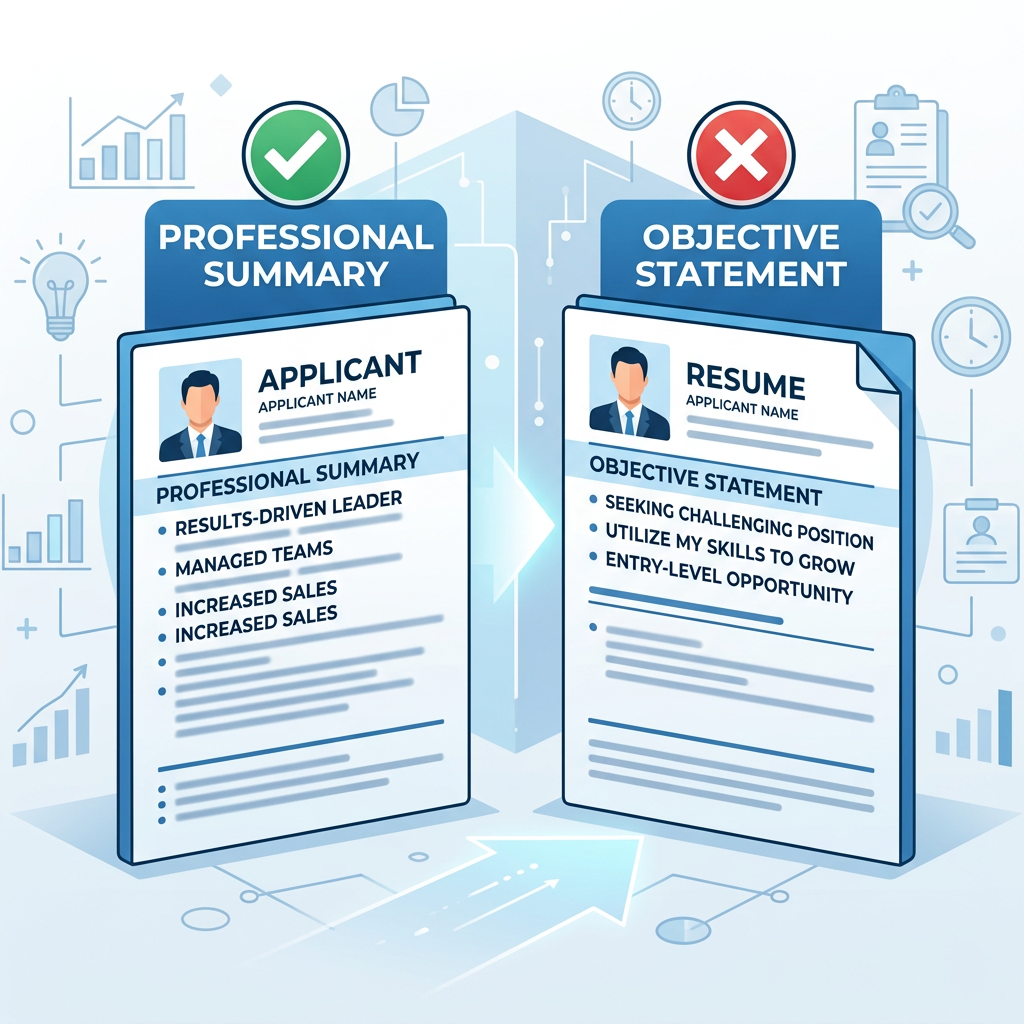
Professional Summary vs. Objective Statement: The Data-Driven Guide to Your Resume's Most Important Section
In 2021, a recruiting team at Deloitte shared an internal finding that reshaped how they trained hiring managers: the professional summary was the single most-read section on a resume. Their eye-tracking data showed that 94% of recruiters read the summary in full, compared to just 68% who read the first experience bullet and only 41% who made it to the education section.
This makes intuitive sense. The summary sits at the top. It's the first substantive content a recruiter encounters after your name and contact information. In the critical 7.4-second initial scan (Ladders, 2024), the summary is often the only section that gets fully read before the recruiter makes a snap judgment.
And yet, many job seekers either skip this section entirely, or worse, fill it with a relic from the 1990s: the objective statement.
This article explains the difference between professional summaries and objective statements, presents the data on which performs better, provides exact formulas and templates for every experience level, and shows you how to write a summary that makes the recruiter stop scanning and start reading.
The Fundamental Difference (And Why It Matters)
Objective Statement
""Seeking a challenging position in marketing where I can utilize my skills and grow professionally."
An objective statement tells the employer what you want from them. It's self-focused. It communicates your needs, your goals, your aspirations.
Professional Summary
""Digital marketing manager with 6 years of experience driving growth for B2B SaaS companies. Specialized in demand generation and content strategy, with a track record of increasing qualified pipeline by 3x and reducing customer acquisition cost by 40%."
A professional summary tells the employer what you offer them. It's value-focused. It communicates your expertise, your track record, and the impact you'll have in their organization.
The difference is philosophical: one is about taking, the other is about giving. And employers, unsurprisingly, prefer candidates who lead with what they bring to the table.
The Data
A 2023 analysis by TopResume found:
| Resume Element | Recruiter Preference | Callback Rate Impact |
|---|---|---|
| Strong professional summary | 87% preferred over objective | +31% higher callback rate |
| Objective statement | 8% still acceptable (career changers) | Neutral to slightly negative |
| No summary/objective at all | 5% acceptable | -17% lower callback rate |
The message is clear: you need something at the top of your resume, and in 87% of cases, it should be a professional summary.
When to Use Each (The Decision Framework)
Use a Professional Summary (95% of candidates)
If any of the following are true, use a professional summary:
- You have 1+ years of relevant work experience
- You're staying in the same industry or adjacent field
- You're applying for a specific type of role
- You have measurable achievements to highlight
Use an Objective Statement (Rare cases only)
An objective statement is appropriate only when:
- You're a complete career changer with zero relevant experience (and even then, a hybrid approach is better)
- You're a student with no work history at all (not even internships or projects)
- The job posting specifically requests an objective
Use the Hybrid Approach (Career Changers)
The hybrid combines the goal-setting of an objective with the value-delivery of a summary:
""Former high school English teacher transitioning to corporate learning and development. 8 years of experience designing curricula for diverse learners, facilitating workshops for groups of 30+, and measuring learning outcomes through assessment analytics. Completed CPTD certification and two corporate training consulting projects for Fortune 500 clients."
This states where you're heading (L&D) while proving you have transferable value (curriculum design, facilitation, measurement) and new credentials (CPTD, consulting projects).
The Professional Summary Formula
Every great professional summary follows a three-line structure:
Line 1: [Title/Role] with [X years] of experience in [specialty/industry]. Line 2: Key expertise in [skill 1], [skill 2], and [skill 3], with a focus on [domain]. Line 3: [Most impressive quantified achievement or value proposition].
This formula works because it answers the three questions every recruiter has when they start reading:
| Question | Your Summary Answers |
|---|---|
| "Who is this person?" | Line 1: Your role identity and experience level |
| "What can they do?" | Line 2: Your specific skills and domain |
| "What have they achieved?" | Line 3: Proof of impact with numbers |
Templates by Experience Level
Entry-Level / Recent Graduate
""Computer Science graduate with hands-on experience in full-stack development through 3 internships and 5 deployed personal projects. Proficient in React, Node.js, Python, and PostgreSQL. Built an e-commerce platform serving 500+ daily users as a senior capstone project, implementing payment processing, inventory management, and real-time analytics."
What makes this work: No mention of "seeking a position" or "eager to learn." Instead: credentials, tools, and a concrete project with scale. An employer reads this and thinks, "This person can ship code."
Mid-Level (3-8 Years)
""Product designer with 5 years of experience creating intuitive B2B interfaces for fintech and SaaS companies. Led the redesign of a trading platform used by 15,000 daily active users, improving task completion rates by 34% and reducing support tickets by 52%. Skilled in Figma, prototyping, design systems, and user research."
What makes this work: Clear specialization (B2B fintech), specific scale (15K DAU), and dual metrics that show both user experience improvement and business impact.
Senior Level (8-15 Years)
""VP of Engineering with 15 years of progressive leadership in high-growth SaaS companies. Built and scaled engineering organizations from 10 to 120+ engineers across 4 countries. Track record of delivering $50M+ in product revenue through strategic technical roadmap execution, while maintaining 99.95% platform uptime for 2M+ users."
What makes this work: The numbers tell a story of scale. 10 → 120 engineers shows growth leadership. $50M in revenue connects engineering to business outcomes. 99.95% uptime shows operational rigor.
Executive Level (15+ Years)
""Chief Marketing Officer with 18 years of experience building category-leading brands in healthcare technology. Architected go-to-market strategies that generated $200M+ in cumulative pipeline across 3 companies. Led marketing organizations of up to 65 people with $12M annual budgets. Board advisor to 2 health-tech startups."
What makes this work: Career-spanning metrics ($200M pipeline), organizational scale (65 people, $12M budget), and governance experience (board advisor) signal executive readiness.
Career Changer
""Operations leader transitioning from military logistics to supply chain management. 10 years of experience managing complex, time-critical supply operations across 3 continents, including $40M in annual materiel logistics. PMP-certified with recent completion of APICS CSCP certification. Led teams of up to 120 personnel in high-pressure environments with zero-tolerance-for-error standards."
What makes this work: Translates military experience into corporate language, adds civilian certifications, and highlights transferable scale and rigor.
The 7 Most Common Summary Mistakes (And Fixes)
| Mistake | Example | Why It Fails | Fix |
|---|---|---|---|
| Too vague | "Experienced professional with strong skills" | Could be anyone in any industry | Add specifics: role, years, industry, skills |
| Too long | 6-sentence paragraph covering your entire career | Recruiters won't read past sentence 3 | 2-4 sentences maximum |
| Too generic | "Detail-oriented team player with excellent communication" | Meaningless buzzwords | Replace with evidence: metrics, tools, outcomes |
| Using "I" | "I am a marketing professional with 5 years..." | Resume convention is implied first person | "Marketing professional with 5 years..." |
| Listing skills without context | "Skilled in Python, SQL, Excel, and PowerPoint" | A list without application means nothing | "Built automated reporting in Python and SQL, processing 2M+ daily records" |
| Focusing on what you want | "Seeking a role where I can grow" | Self-focused, not value-focused | "Bringing 5 years of [skill] to drive [outcome]" |
| Including personality traits | "Creative, passionate, driven self-starter" | Unverifiable adjectives | Show creativity through creative achievements |
Industry-Specific Summary Strategies
Technology
Lead with your technical stack and your highest-impact system. Tech recruiters scan for specific languages, frameworks, and scale indicators.
""Backend engineer specializing in distributed systems (Go, Kubernetes, gRPC). Designed and maintained services processing 45M daily transactions at 99.99% uptime for a Series D fintech platform."
Finance
Lead with your license/certification and AUM or deal flow. Finance recruiters look for credentials and numbers.
""CFA Charterholder and Portfolio Manager with $450M AUM. 12 years of experience in institutional equity management, consistently outperforming benchmark by 180bps annually."
Healthcare
Lead with your clinical specialty and patient outcomes. Healthcare recruiters value licensure and measurable care quality.
""Board-certified Emergency Medicine physician with 10 years of clinical experience in Level I trauma centers. Managed 4,500+ annual patient encounters with 98th percentile patient satisfaction scores."
Marketing
Lead with your channel expertise and revenue attribution. Marketing recruiters want to see pipeline and ROI.
""Growth marketing leader specializing in paid acquisition (Google, Meta, LinkedIn) for B2B SaaS. Generated $18M in attributable pipeline revenue while reducing CAC by 40% through multi-touch attribution and creative testing."
Sales
Lead with your quota attainment and deal size. Sales recruiters live and die by numbers.
""Enterprise Account Executive with 7 consecutive years of quota attainment (avg. 128%). Closed $12M in annual contract value across healthcare and financial services verticals, with an average deal size of $340K."
The ATS Dimension: Keyword Strategy for Your Summary
Your professional summary is prime real estate for ATS keywords. The summary is among the first sections parsed and is weighted heavily by matching algorithms.
Strategic keyword placement:
| Keyword Type | Where to Include | Example |
|---|---|---|
| Job title | Line 1 of summary | "Senior Product Manager..." |
| Industry | Line 1 of summary | "...in B2B SaaS" |
| Core skills | Line 2 of summary | "...demand generation, ABM, and marketing automation" |
| Tools | Line 2-3 of summary | "...HubSpot, Salesforce, and Google Analytics" |
| Strongest metric | Line 3 of summary | "...3x pipeline growth" |
This means your summary does double duty: it persuades human readers and feeds ATS matching algorithms the keywords they need to score you highly.
Write Your Summary on fullCV.online
fullCV.online includes an AI summary generator that creates tailored professional summaries based on your experience, skills, and target role. It writes in the right tone, at the right length, with the right keywords — and you can regenerate until it's perfect.
Your summary is the most-read section on your resume. Make it count.