The State of the German Job Market in 2026
In early 2025, the German Federal Employment Agency (Bundesagentur für Arbeit) reported a staggering 760,000 unfilled positions across the country. By 2026, this labor shortage has evolved into a strategic crisis for German industry, particularly in tech, engineering, and healthcare. For international and local candidates alike, this represents a golden era. However, the German market remains notoriously specific about its application standards. Using a free resume builder to align with these standards is no longer just an advantage—it is a necessity.
Take the case of Marcus, a Senior DevOps Engineer from Brazil. Despite a decade of experience at top-tier firms, his initial 40 applications to Berlin-based startups yielded zero interviews. The culprit? A single-page 'American-style' resume that lacked the formal structural elements German recruiters expect. After transitioning to a traditional tabellarischer Lebenslauf (tabular CV) with a professional headshot and detailed certifications, Marcus secured three interviews in a single week, eventually landing a €95,000 role with a Tier-1 automotive firm.
Germany's 'Opportunity Card' (Chancenkarte), fully matured in 2026, has streamlined the visa process, but the technical barrier remains the CV. To succeed, you must blend modern AI efficiency with the rigorous tradition of German corporate culture.
Understanding the German CV (Lebenslauf) Structure
Unlike the flexible formats seen in the UK or the US, the German Lebenslauf follows a strict, chronological, and highly detailed structure. In 2026, while some international startups in Berlin or Munich accept 'modern' resumes, the vast majority of German Mittelstand (medium-sized enterprises) and DAX-listed companies require a traditional approach. Using an online CV maker ensures you don't miss these critical cultural markers.
The Tabular Layout
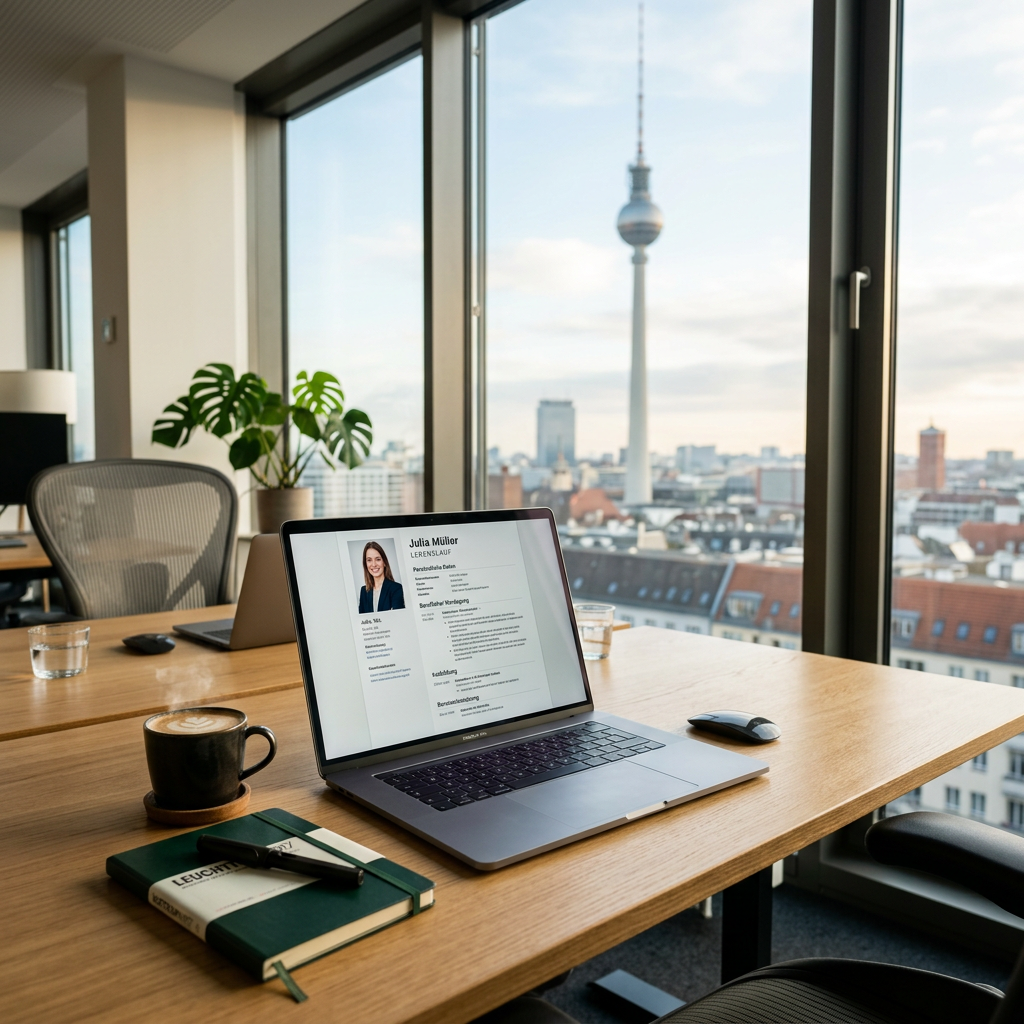
Your CV must be presented in a clear, tabular format. This means two columns: the left for dates and categories, and the right for descriptions. It should be comprehensive, often stretching to two or three pages—a stark contrast to the one-page rule prevalent elsewhere. Recruiters in Germany value 'Lückenlose' (gapless) histories. If you took six months off to travel or upskill, you must list it.
Personal Details and the 'Photo Question'
While the General Act on Equal Treatment (AGG) technically forbids discrimination based on appearance, the professional headshot remains a standard expectation in Germany. A high-quality, professional photo placed in the top right corner signals seriousness. Additionally, German CVs often include personal details that would be omitted elsewhere, such as date of birth, place of birth, and sometimes even marital status (though this is becoming less common in 2026).
""In Germany, a CV is not just a marketing document; it is a formal record of your professional journey. Precision, honesty, and structure are the three pillars of a successful application." — Dr. Hans Müller, Senior Recruitment Consultant at a Top-4 German Agency.
The Importance of 'Zeugnisse'
In Germany, your word is rarely enough. Every claim on your CV should ideally be backed by a Zeugnis (certificate or reference). This includes university degrees, vocational certificates, and Arbeitszeugnisse (work references) from previous employers. When you build your resume, ensure you have these documents ready to attach as a single PDF alongside your CV and cover letter.
Comparison: International vs. German CV Standards 2026
| Feature | International (US/UK) | German (Lebenslauf) |
|---|---|---|
| Length | Strictly 1-2 pages | 2-3 pages common |
| Photo | Discouraged/Forbidden | Highly recommended |
| Structure | Reverse-chronological | Tabular (Chronological) |
| Personal Info | Minimal (Name/Contact) | Extensive (DOB/Nationality) |
| References | 'Available on request' | Formal 'Zeugnisse' attached |
| Style | Achievement-oriented | Detail-oriented & Formal |
Mastering the ATS in the German Market
By 2026, over 85% of German companies with more than 500 employees use advanced Applicant Tracking Systems (ATS) like Workday, SAP SuccessFactors, or Personio. These systems are now equipped with German-specific LLMs (Large Language Models) designed to parse complex compound German words.
To pass these digital gatekeepers, your CV must be optimized. Our professional resume tool utilizes AI to ensure your document is readable by these specific algorithms while maintaining the aesthetic standards of a German human recruiter.
Keywords to Include
Focus on 'Hard Skills' and industry-specific certifications. For example, if you are an engineer, terms like 'Projektmanagement,' 'Qualitätsmanagement,' or 'TÜV-zertifiziert' carry immense weight. In 2026, sustainability and digital transformation are the two biggest keyword drivers in the German economy. If you have experience with 'Nachhaltigkeit' (sustainability) or 'Digitalisierung,' ensure these are prominent.
High-Growth Sectors and Salaries in Germany 2026
Understanding where the money is flowing is crucial for positioning your CV. The German government's 2026 economic forecast highlights a massive pivot toward green energy and AI integration.
| Industry Sector | High-Value Role | Expected Salary Range (2026) |
|---|---|---|
| Renewable Energy | Hydrogen Systems Engineer | €85,000 - €110,000 |
| Information Technology | AI Ethics & Compliance Officer | €90,000 - €125,000 |
| Healthcare | Digital Health Project Manager | €75,000 - €95,000 |
| Logistics | Supply Chain Automation Specialist | €70,000 - €90,000 |
| Finance | Fintech Regulatory Expert | €80,000 - €115,000 |
To target these salaries, you need more than just experience; you need a presentation that justifies the investment. You can create your CV now using templates specifically designed for these high-paying sectors.
Language Requirements: English vs. German
A common question in 2026 is: "Do I need to write my CV in German?" The answer depends on the company culture.
- Startups & Tech Giants: Companies like Zalando, HelloFresh, or Google in Munich often use English as the primary office language. An English CV is perfectly acceptable.
- The Mittelstand: For the backbone of the German economy—family-owned global leaders—a German CV is almost mandatory. Even if you will speak English at work, the HR manager vetting your application likely prefers German.
Our platform offers multi-language support in 50+ languages, allowing you to easily translate and adapt your content for different types of German employers. If you are applying for a role that requires 'B2 German,' submitting a German CV is the first proof of your proficiency.
The Role of the 'Anschreiben' (Cover Letter)
In many markets, the cover letter is dying. In Germany, it remains alive and well. The Anschreiben is a formal, one-page document that explains your motivation. It should follow the DIN 5008 standard—a German national standard for the layout of business letters.
Your cover letter should answer three questions:
- Why this company?
- Why this role?
- Why are you the solution to their specific problem?
To save time, use our cover letter generator to create a document that matches the design of your CV, creating a cohesive and professional 'Bewerbungsmappe' (application folder). At affordable plans starting at just $3.99, you can export these documents with the confidence that they meet German professional standards.
Step-by-Step Guide to Writing Your German CV
- Header: Include your name, address, phone number, email, and LinkedIn profile.
- Professional Photo: A high-resolution headshot, usually cropped to a portrait ratio, placed in the top right.
- Personal Information: (Optional but standard) Date of birth, place of birth, and nationality.
- Work Experience: In reverse-chronological order. Include the company name, location, your title, and bullet points of responsibilities and quantifiable achievements.
- Education: List your degrees, institutions, and final grades (German recruiters love grades). If you are an international student, mention the German equivalent of your degree (e.g., 'Master-äquivalent').
- Skills & Certifications: Languages (using the CEFR scale: A1-C2), software, and technical certifications.
- Interests: Keep it brief but professional. It shows 'Kulturpassung' (cultural fit).
- Signature & Date: Unlike digital-first markets, many German recruiters still appreciate a scanned signature at the bottom of the CV to attest to the truthfulness of the information.
You can manage your CVs and create multiple versions for different industries directly from your user profile, making it easy to tailor each application.
Leveraging AI for Your German Application
AI has transformed job searching in 2026. However, the 'human touch' is still highly valued in German business culture. The key is to use AI for structure and translation, while manually refining the professional tone.
Our AI resume builder helps you generate bullet points that focus on 'Leistung' (performance). Instead of saying "I managed a team," the AI will suggest "Led a cross-functional team of 10 to increase production efficiency by 15% within the 2025 fiscal year." This level of specificity is what German hiring managers look for.
Furthermore, utilize professional profile pages with analytics to see when a German recruiter has viewed your application. In a market where 'Datenschutz' (data protection) is king, having a secure, professional link to share your credentials can set you apart from candidates sending cluttered email attachments.
Final Checklist for Your German CV 2026
Before you hit send on that application to Siemens, BASF, or a hot Berlin fintech, run through this checklist:
- Is the layout tabular and easy to read?
- Is there a professional photo in the top right?
- Are there no gaps in your timeline?
- Have you included your 'Zeugnisse' (certificates) in the PDF bundle?
- Is the file named professionally (e.g.,
Vorname_Nachname_Lebenslauf.pdf)? - Did you use one of our 30+ ATS-optimized templates to ensure compatibility?
Conclusion: Your Career in Germany Awaits
Germany in 2026 is a land of immense opportunity for those who respect its traditions while bringing modern skills to the table. The transition to Europe’s largest economy requires a CV that speaks the language of German recruitment—precision, formality, and proven expertise.
Don't let a formatting error stand between you and a six-figure salary in Hamburg, Frankfurt, or Munich. By using a professional resume tool, you ensure that your first impression is not just good, but 'ausgezeichnet' (excellent).
Ready to take the first step? Start your resume today and join the thousands of professionals who have successfully navigated the German job market with our help. Visit our career blog for more industry-specific tips and 2026 market insights.