
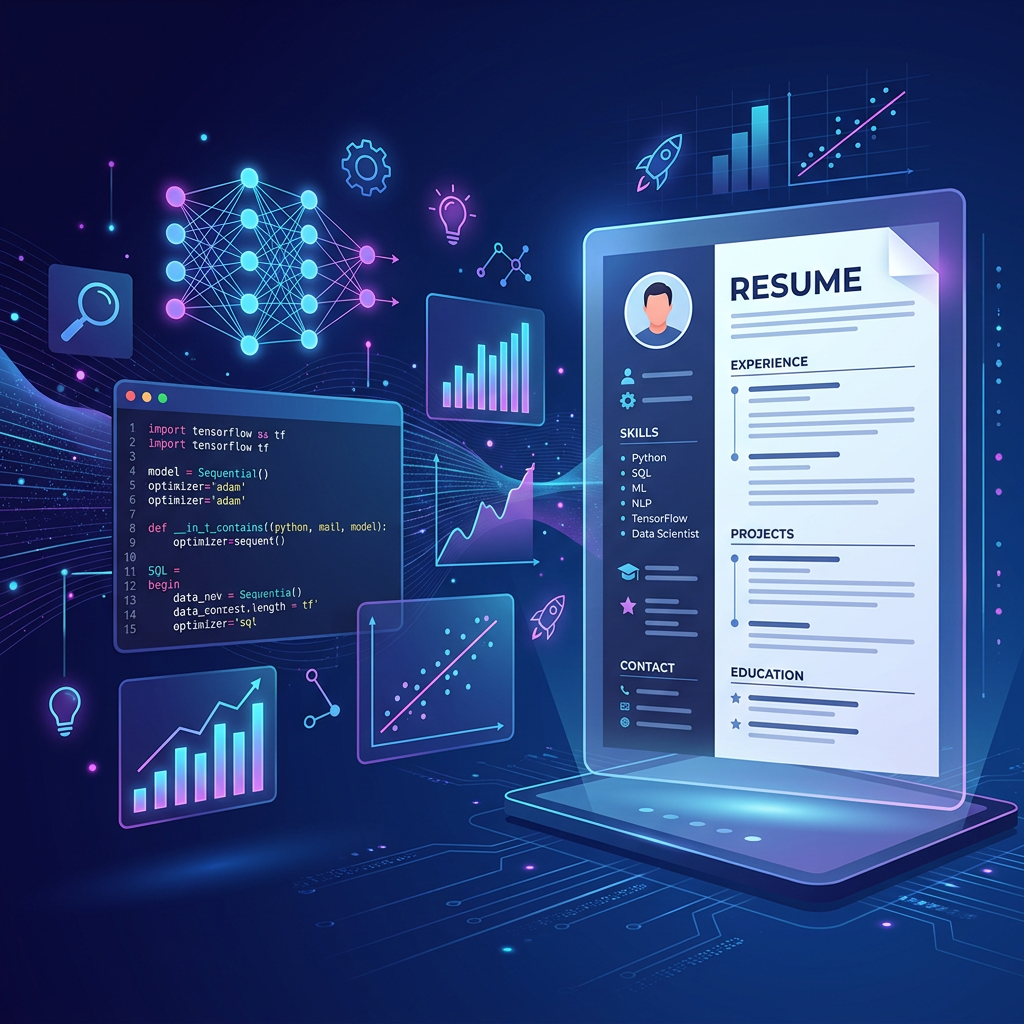
Data Science Resumes Need Business Context
Recruiting for data science has matured. In 2026, hiring managers aren't just looking for someone who knows TensorFlow. They want someone who can define the right problem, build the right model, and explain the business impact.
Your resume needs to show all three.
The Ideal Structure
- Professional Summary (specialty + years + one standout result)
- Technical Skills (organized by category)
- Professional Experience (business-framed achievements)
- Projects (personal or open-source work that shows initiative)
- Education (degrees, relevant coursework)
- Publications / Talks (if applicable)
Technical Skills: How to Organize Them
Don't dump 40 tools in a paragraph. Categorize:
| Category | Example Skills |
|---|---|
| Languages | Python, R, SQL, Scala |
| ML/DL Frameworks | PyTorch, TensorFlow, scikit-learn, XGBoost |
| Data Engineering | Spark, Airflow, dbt, Kafka |
| Cloud & MLOps | AWS SageMaker, GCP Vertex AI, MLflow, Kubeflow |
| Visualization | Tableau, Power BI, Matplotlib, Plotly |
| Databases | PostgreSQL, MongoDB, Snowflake, BigQuery |
Prioritize tools mentioned in the job description.
Experience Bullets: The Impact Formula
Every data science bullet should follow: Problem → Approach → Impact
Weak: "Built a churn prediction model using XGBoost"
Strong: "Developed an XGBoost churn prediction model (AUC 0.91) that identified at-risk accounts 30 days early, enabling targeted retention campaigns that reduced quarterly churn by 18% ($1.2M saved)"
Notice the difference: the strong version includes model performance, business context, and dollar impact.
More examples:
- "Designed a recommendation engine serving 2M daily users, increasing average session duration by 23% and driving $800K in incremental annual revenue"
- "Built an NLP pipeline for automated document classification, processing 50K documents/day with 94% accuracy, replacing 3 FTEs of manual review"
- "Created real-time fraud detection system using gradient boosting, catching $4.2M in fraudulent transactions in Q1 with a 0.3% false positive rate"
The Projects Section
For data scientists, projects are almost as important as experience:
- Kaggle competitions (mention ranking and approach)
- Open-source contributions (link to GitHub)
- Research papers (even unpublished preprints)
- Personal dashboards or tools (deployed and accessible)
Example:
Customer Segmentation Engine | github.com/you/project
- Built unsupervised clustering pipeline using K-means and DBSCAN on 500K customer records
- Deployed interactive dashboard with Streamlit, used by marketing team for campaign targeting
- Technologies: Python, scikit-learn, Streamlit, AWS EC2
ATS Keywords for Data Science
Common keywords ATS filters for:
- Machine learning, deep learning, NLP, computer vision
- A/B testing, statistical analysis, hypothesis testing
- Feature engineering, model deployment, MLOps
- ETL, data pipeline, data warehouse
- Specific tools from the job description
Education Section Tips
- PhD: Include thesis title and key research areas
- Master's: List relevant coursework and capstone project
- Bachelor's: Relevant if in CS, Stats, Math, or related field
- Bootcamp: Include if it's well-known (Insight, Springboard, etc.)
Build Your Data Science Resume
fullCV.online has clean templates that handle technical resumes beautifully. The skills section, project section, and ATS optimizer help ensure your data science resume passes both automated screening and human review.