
Resume Summary vs. Resume Objective: Which One Should You Use in 2026? A Complete Decision Framework
The Quick Answer
Use a professional summary in 90% of cases. It's more effective, more modern, and better received by both recruiters and ATS systems.
But the 10% where an objective is better matters — and getting it wrong can cost you interviews. This guide gives you a clear decision framework, templates for both, and examples across 10+ industries so you can get it right the first time.
What's the Difference? A Side-by-Side Analysis
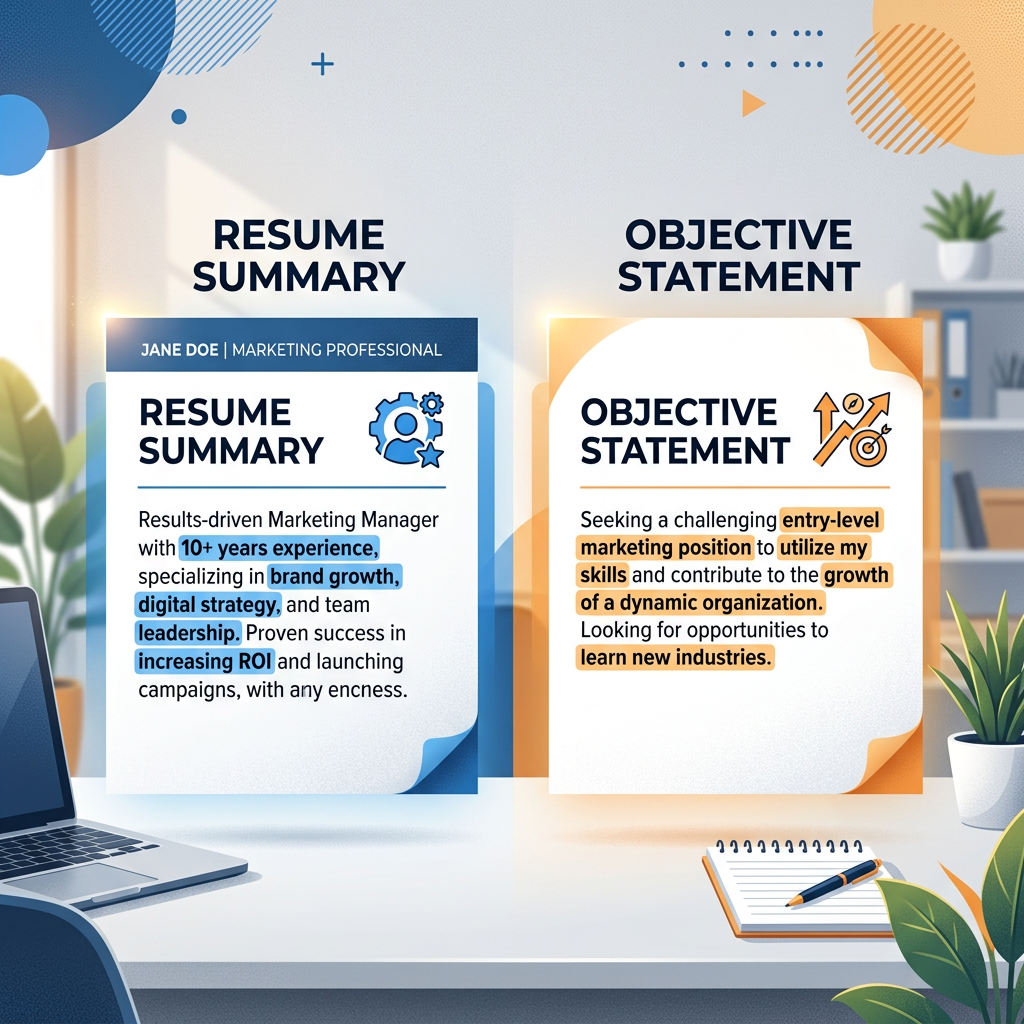
The Resume Objective
A resume objective focuses on what you want from the employer. It states your career goals and the type of position you're seeking.
"Seeking a challenging position in marketing where I can utilize my skills and grow professionally."
This tells the employer what you want. It doesn't tell them what you offer. And in a competitive job market, that's a critical failure.
The Professional Summary
A professional summary focuses on what you offer the employer. It communicates your value proposition in 3-4 sentences.
"Data-driven marketing manager with 7 years of experience driving B2B SaaS growth. Led campaigns generating $12M in pipeline across North American and European markets. Expert in demand generation, ABM strategy, and marketing analytics using HubSpot and Salesforce. Seeking to bring this growth expertise to a Series B-C company ready to scale."
This immediately communicates value, expertise, and fit — everything a hiring manager needs to decide whether to keep reading.
The Critical Comparison
| Dimension | Resume Objective | Professional Summary |
|---|---|---|
| Focus | What you want | What you offer |
| Perspective | Candidate-centered | Employer-centered |
| Tone | Aspirational, passive | Confident, active |
| ATS performance | Weak (few keywords) | Strong (keyword-rich) |
| Recruiter preference | Outdated since ~2015 | Industry standard |
| Length | 1-2 sentences | 3-4 sentences |
| Best for | Career changers, entry-level | Everyone else |
| Impression created | "I need something" | "I bring something" |
Why Professional Summaries Win: The Three Reasons
Reason 1: Recruiter Psychology
Hiring managers scan your resume in 6-7 seconds (TheLadders eye-tracking study). In those seconds, they need to answer one question: "Is this person worth a closer look?"
A summary gives them your value proposition instantly — years of experience, key expertise, top achievement, and relevance to the role. An objective makes them work to figure out why they should care. In a stack of 200 resumes, the ones that communicate value fastest win.
Reason 2: ATS Keyword Optimization
Professional summaries naturally include keywords from your industry — job titles, skills, tools, certifications, and achievement metrics. These are exactly the terms that ATS systems scan for.
Objectives tend to be generic and keyword-poor: "Seeking a challenging position" contains zero matchable keywords. "B2B demand generation manager with expertise in HubSpot, Salesforce, and ABM strategy" contains four high-value keywords in a single sentence.
Reason 3: Positioning Power
A summary positions you as a solution to the employer's problem — someone who brings specific, proven value. An objective positions you as someone who has a problem (needing a job) and hopes the employer will solve it.
In a competitive market, you want to be the solution, not the problem.
When an Objective Still Makes Sense: The Three Exceptions
Exception 1: Career Change
When your experience doesn't directly match the target role, an objective (or a hybrid statement) can bridge the gap by explaining your transition and why it makes sense.
Template for career changers: "[Current expertise] professional transitioning to [target field]. Combining [X] years of [transferable skill 1] and [transferable skill 2] with [new credential/training]. Seeking [specific role] where I can apply [domain knowledge] to [target industry problem]."
Example: "Experienced financial analyst transitioning to data science. Combining 5 years of quantitative modeling and statistical analysis with recently completed certifications in Python, machine learning (scikit-learn, TensorFlow), and SQL. Seeking a junior data scientist role in fintech where I can apply financial domain expertise to predictive analytics and risk modeling."
Note: This is really a hybrid — it states an objective but leads with qualifications. That's the right approach.
Exception 2: Entry-Level / Recent Graduate
When you have minimal or no professional experience to summarize, a modified objective can work — but only if it leads with what you bring, not what you want.
Template for new graduates: "Recent [Degree] graduate from [University] with specialization in [field]. [Key project, thesis, or internship achievement]. Seeking [specific role] at [type of company] where I can apply [specific skill] and contribute to [specific goal]."
Example: "Recent Computer Science graduate from ETH Zurich with specialization in distributed systems and a thesis on fault-tolerant consensus algorithms. Built a real-time data pipeline processing 2M+ events/day during internship at Spotify. Seeking a backend engineering role at a growth-stage startup where I can apply distributed systems expertise to infrastructure challenges at scale."
Exception 3: Industry-Specific Norms
Some fields — academic positions (where a "Research Interests" statement is standard), certain government roles, and some international markets — still expect objective-style openings. If the job posting or industry norm clearly calls for an objective, follow the convention.
How to Write a Professional Summary That Gets Interviews: The Formula
The four-part formula:
[Identity + Years] + [Core Expertise] + [Top Achievement] + [Value Proposition / Target]
Step-by-Step Breakdown
-
Identity + Years: Establish who you are professionally. "Senior product manager with 8 years of experience" or "Full-stack engineer with a decade of experience in fintech."
-
Core Expertise: Your 2-3 primary skills or areas of specialization. "Specializing in B2B SaaS growth, demand generation, and marketing analytics."
-
Top Achievement: Your single most impressive, quantified accomplishment. "Led product launch that generated $8M ARR in first year" or "Built and scaled engineering team from 4 to 28 engineers."
-
Value Proposition / Target: What you bring to the target role specifically. "Seeking to bring enterprise growth expertise to a Series B company ready to scale internationally."
Industry-Specific Examples
Software Engineering: "Full-stack engineer with 6 years of experience building high-traffic web applications in React, Node.js, and PostgreSQL. Architected the real-time notification system serving 2.4M daily active users at current company, reducing page load time by 62%. AWS Certified Solutions Architect with deep expertise in microservices, CI/CD, and infrastructure-as-code."
Marketing: "Performance marketing manager with 5 years of experience driving growth for B2B SaaS companies. Scaled paid acquisition from $200K to $3.2M annual spend while maintaining 4.2x ROAS. Expert in Google Ads, Meta Ads, HubSpot, and multi-touch attribution modeling."
Healthcare: "Registered Nurse (BSN, RN) with 8 years of critical care experience across Level 1 trauma centers. Achieved 99.2% medication safety compliance over 3-year period and mentored 15+ new graduate nurses. ACLS, PALS, and TNCC certified with specialization in cardiac critical care."
Finance: "CFA charterholder and portfolio analyst with 6 years of experience managing $450M in institutional fixed-income assets. Generated 180bps of alpha over benchmark during 2023-2025 cycle through proprietary credit analysis framework. Expert in Bloomberg Terminal, FactSet, and quantitative risk modeling."
Project Management: "PMP-certified project manager with 9 years of experience delivering enterprise software implementations on time and under budget. Led 14 concurrent workstreams for a $22M digital transformation at a Fortune 500 retailer, achieving 100% milestone delivery. Expert in Agile, Scrum, and hybrid methodologies using Jira and Confluence."
Design: "Senior UX designer with 7 years of experience creating intuitive, accessible digital products for fintech and healthcare. Redesigned onboarding flow that increased user activation by 340% and reduced support tickets by 58%. Proficient in Figma, user research, design systems, and WCAG 2.1 accessibility compliance."
Common Mistakes to Avoid
In Professional Summaries:
- Generic claims without evidence. "Highly motivated team player" means nothing. Replace with specific achievements.
- Too long. 3-4 sentences maximum. If it's a paragraph, it's too long.
- Written in third person. "John is a skilled developer" feels awkward. Use implied first person (omit "I").
- No numbers. A summary without at least one quantified achievement is missing its most powerful element.
- Copy-pasted for every application. Your summary should be customized — or at least adjusted — for each target role.
In Resume Objectives:
- Too vague. "Seeking a challenging opportunity" could apply to any job on earth.
- Focusing entirely on your needs. Employers care about what you bring, not what you want.
- Using buzzwords. "Synergize," "leverage," "utilize" — these add zero value.
The Hybrid Approach: Best of Both Worlds
For career changers and transitioners, the most effective approach combines elements of both:
"[Summary of what you bring from your previous career] + [What you're transitioning to and why] + [Specific value you'll add in the new role]"
This gives employers confidence in your existing competence while clearly communicating your direction.
Build Your Summary With AI Assistance
fullCV.online includes an AI writing assistant that helps you craft your professional summary:
- Analyzes your experience to identify your strongest achievements
- Suggests industry-specific keywords for ATS optimization
- Generates summary options tailored to your target role
- Checks keyword alignment against job descriptions
Whether you need a powerful summary or a strategic objective, the right opening sets the tone for your entire resume — and determines whether those critical first 6 seconds work in your favor.